Remodeling · June 4, 2026 · 9 min read
Tile That Lasts: How Proper Waterproofing Protects Your Sacramento Bathroom
The most important part of a tile shower is the part you'll never see. Here's how proper waterproofing keeps water out of your Sacramento home's walls and subfloor for 20-plus years.
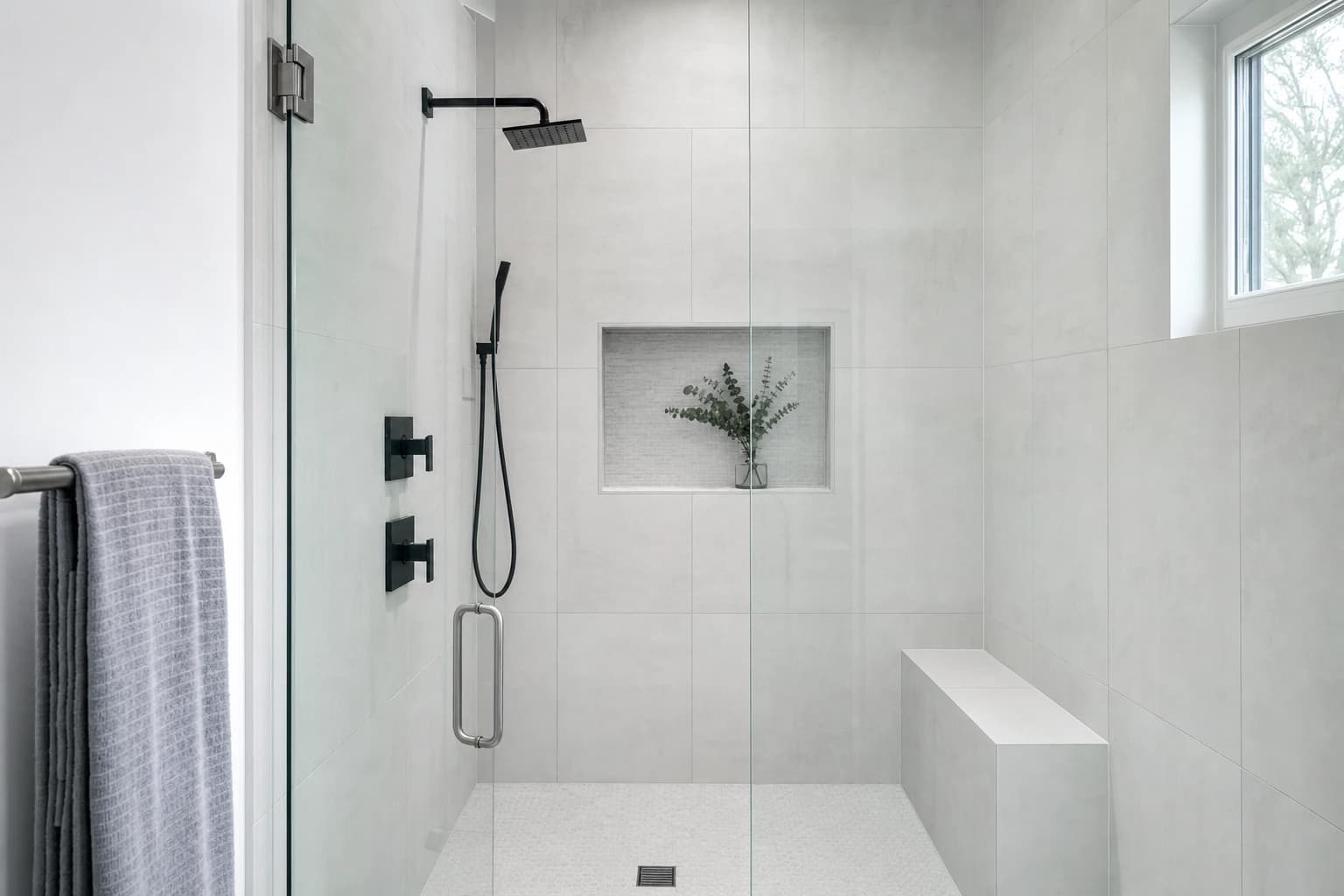
Walk into a beautifully tiled shower and your eye goes straight to the finish: the large-format porcelain, the crisp grout lines, the recessed niche, the frameless glass. What you can't see is the part that decides whether that shower is still sound in 20 years or rotting behind the wall in five. That part is the waterproofing, and it is, hands down, the single most important step in any tile bathroom.
Here's the truth most homeowners never hear: tile and grout are not waterproof. Grout is porous, and cement board is not a moisture barrier. Water passes through both, every single shower. If there's a proper waterproofing layer behind them to catch it and send it back to the drain, your walls and subfloor stay bone dry for decades. If there isn't, water soaks into framing and subfloor and you get slow, hidden failures that turn a cosmetic remodel into a structural repair. We're VDO Remodeling, a licensed B-2 interior remodeling contractor based in Rancho Cordova (CSLB #1107954), and across our work in Sacramento, Folsom, Carmichael, Citrus Heights, Fair Oaks, and Arden-Arcade, waterproofing is the one part of the job we will never hand off or cut corners on. Here's why.
Why Waterproofing Is the Part That Fails First
When a tile shower fails, it almost never fails at the tile. It fails behind it. The most common scenario we open up in older Sacramento homes is tile set directly over cement board or, worse, over moisture-soaked drywall, with no membrane between. Everything looks fine for a while. Then the grout develops hairline cracks, the caulk shrinks, and water starts finding its way through.
With nothing to stop it, that water wicks into the studs and subfloor. You smell something faint after a hot shower, notice a soft spot near the threshold, or see a stain bleed through the ceiling below. By the time it's visible, the damage has been building for years. We've torn out showers only six or seven years old where the bottom plate of the wall crumbled in our hands. This is the textbook example of craftsmanship you can't see but absolutely feel later, which is exactly why it's the first thing a cut-rate job skips.
Tile and Grout Are Finishes, Not Barriers
Let's settle the most important misconception directly, because so much depends on it.
- Grout is porous. Standard cement grout absorbs water. Sealing slows that down but doesn't stop it, and sealer wears off. Grout locks tiles in place and looks clean; it does not keep water out.
- Tile bodies vary. Porcelain is dense and absorbs very little; natural stone and many ceramics absorb more. Either way, water travels through the grout joints regardless of the tile.
- Cement board is not waterproof. Backer board (like Durock or HardieBacker) is a stable, rot-resistant substrate, but water passes straight through it. It needs a dedicated waterproofing layer to actually protect the structure.
So the real waterproofing in a properly built shower lives in a layer behind the tile. Get it right and the tile does its job for 20-plus years. Get it wrong and the prettiest tile in Folsom won't save the wall behind it.
The Systems We Trust: Schluter Kerdi, RedGard, and Equivalents
There are two main families of modern waterproofing, and both work beautifully when installed by hand with care. The right choice depends on the shower, the substrate, and the design.
Sheet Membranes (Schluter Kerdi and Similar)
A bonded sheet membrane like Schluter Kerdi is a thin, flexible fabric-backed sheet adhered to the substrate with thinset, with all seams and corners overlapped and sealed into a continuous waterproof skin over the walls, curb, and pan. Schluter also makes preformed niches, curbs, benches, and a sloped pan that integrate with the membrane, so the whole shower becomes one sealed system rather than a patchwork. For a fully custom shower, this is often our preferred approach because every transition is engineered to stay sealed.
Liquid-Applied Membranes (RedGard and Similar)
A liquid membrane like RedGard is rolled or troweled on in two coats, building up to a continuous rubbery film. Around plumbing penetrations, inside corners, and changes of plane, we embed reinforcing fabric so those high-stress spots get extra protection. Liquid membranes are excellent for irregular shapes, benches, and tight detail work, and bond tenaciously at the right thickness over properly prepped board.
Both systems are proven and code-recognized. What matters far more than which one we use is how carefully it's installed: full coverage with no thin spots, lapped seams, reinforced corners, and sealed penetrations. A premium membrane installed carelessly still leaks; a good membrane installed meticulously lasts decades.
The Shower Pan: Where Most Leaks Actually Start
If walls are where homeowners worry, the pan is where the pros worry. The base takes the most water and foot traffic. A proper pan does two things at once: stays waterproof, and slopes so water always runs to the drain instead of pooling.
- Slope to drain. A consistent pitch (roughly a quarter inch per foot). Flat spots hold water, and standing water eventually finds a weak point.
- Integrated, bonded drain. The membrane has to tie cleanly into the drain so there's no gap where the two meet. A bonding-flange drain (Kerdi-style) or properly clamped traditional drain is essential, and this connection is a classic failure point in cheap builds.
- Continuous transition up the walls. The pan and wall membranes must overlap so there's no seam at the floor-to-wall corner, the most vulnerable joint in the shower.
- Curb wrapped completely. The curb gets soaked from both sides. It needs to be fully membrane-wrapped, not just tiled over.
Whether we build the pan with a sloped foam tray and bonded membrane or a traditional mortar bed with the right liner, the principle is the same: one continuous waterproof basin under the tile that can only drain in one direction.
Niches, Benches, and Every Penetration
Every time you cut into a shower wall, you create a potential leak, and the detailing at each one decides whether it holds. Niches have a floor that collects water and four inside corners, so we slope the floor slightly toward the shower and waterproof the entire box, corners reinforced, before any tile goes in; a niche tiled over bare board does not last. Benches get a sloped top and full membrane coverage so water sheds off rather than soaking in at the wall joint. Valves and plumbing penetrations get sealed with gaskets or reinforced collars so water can't track along the pipe into the wall cavity. These details are invisible once the tile is set, and they're exactly where the difference between a shower that lasts and one that fails is decided.
Substrate Prep: The Foundation Under the Foundation
Waterproofing is only as good as what it's bonded to. Before any membrane goes on, the substrate has to be right.
- Remove everything compromised. Any drywall, framing, or subfloor that's water-damaged from a previous failure comes out. We will not waterproof over a problem.
- Use the correct backer. Cement board or foam tile-backer board, fastened at the right spacing, with seams treated. Green drywall is not an acceptable wet-area substrate in a shower, full stop.
- Flat and solid. Flex and deflection crack tile and stress the membrane over time, which is why floor framing and subfloor stiffness matter as much as the board on the walls.
In older Sacramento and Carmichael homes especially, this stage is where we find the surprises: previous leaks, undersized framing, or a subfloor that's seen better days. Dealing with it honestly here is the whole point.
Pressure-Testing Before a Single Tile Goes Down
Here's the step that separates careful builders from the rest, and the one we wish every homeowner knew to ask about. Before any tile is set, the shower pan can be flood-tested. We plug the drain, fill the pan to the top of the curb, mark the level, and let it sit overnight or a full 24 hours. If the level holds, the pan is watertight. If it drops, we find and fix the leak now, while it's a quick repair instead of a demolition project. Once the tile is on, finding a pan leak means tearing out finished work, so flood-testing first is cheap insurance, and it's exactly the kind of step that gets skipped when a job is rushed or underbid.
Why This Is the Part We Refuse to Subcontract
Much of a bathroom can be coordinated across trades. Waterproofing is the one stage where we keep our own hands on the work start to finish, because it's invisible, unforgiving, and the consequences land on you years later. The same people who prep the substrate install the membrane, wrap the niche, build the pan, and run the flood test. There's no handoff where a corner gets cut because "someone else will tile over it."
A note on scope, because we believe in being straight about it: under our B-2 license, we handle the full interior bathroom remodel, demolition, substrate, waterproofing, tile, fixtures, finish work, and coordinating licensed plumbing and electrical subs for rough-ins within your existing walls. Relocating the drain to a brand-new location, running a new main, or removing a load-bearing wall goes beyond the B-2 scope and calls for the right specialty contractor, which we'll bring in and coordinate if your project needs it.
Build It Once, Build It Right
The cheapest tile shower and the most durable one can look identical the day they're finished. The difference shows up years later, behind the wall, where you can't see it until it's a problem. Done right, you get a shower that simply works, quietly, for 20 years or more: no musty smell, no soft threshold, no surprise rot when you sell. The tile you picked stays beautiful because the structure behind it stays dry.
At VDO Remodeling, we've built tile showers this way for homeowners across Sacramento, Folsom, Rancho Cordova, Carmichael, Citrus Heights, and Fair Oaks, and we treat the waterproofing as the most important hour of the entire job. We're a licensed B-2 interior remodeling contractor (CSLB #1107954), fully insured, with honest line-item pricing.
Planning a bathroom remodel and want it built to last? Call or text VDO Remodeling at (916) 232-5571 for a free, no-obligation in-home consultation. Licensed, insured, CSLB #1107954.