Remodeling · June 6, 2026 · 8 min read
Aging in Place: Accessible Bathroom Remodels for Sacramento Homes
Want a bathroom that stays safe for decades without looking like a hospital? Here is how Sacramento homeowners are building accessible, age-in-place bathrooms that are genuinely beautiful.
Most people who call us about an "accessible" bathroom start the same way: they don't want it to look like a hospital room. They picture stainless rails bolted to white tile and a shower seat from a medical-supply catalog. That picture is decades out of date.
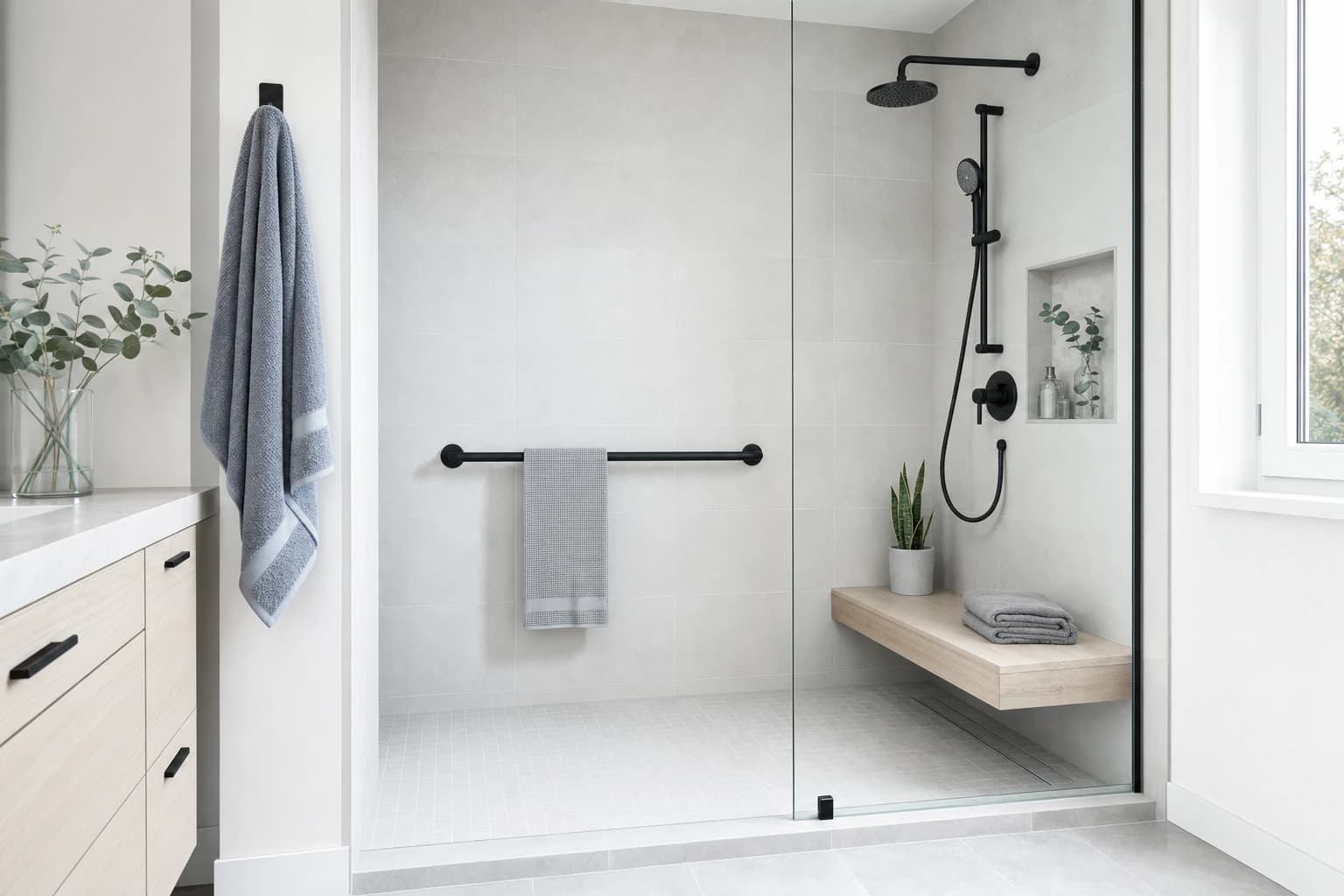
A well-designed aging-in-place bathroom is often indistinguishable from a high-end modern bathroom. The safety is built into details you'd never notice unless you knew to look. A curbless shower reads as sleek and contemporary, not clinical. A grab bar in matte black or brushed brass looks like a towel bar. Done correctly, the room is safer for an 80-year-old and more comfortable for everyone else in the house at once.
We're VDO Remodeling, a licensed B-2 interior remodeling contractor based in Rancho Cordova (CSLB #1107954). We build accessible bathrooms for homeowners across Sacramento, Folsom, Carmichael, Citrus Heights, Fair Oaks, and Arden-Arcade who plan to stay in their homes for the long haul. This guide covers what actually makes a bathroom safe to age in, and how to get all of it without sacrificing an ounce of style, all on your existing interior footprint.
Why Aging in Place Starts in the Bathroom
If you're going to invest in one room to support staying in your home, it's the bathroom. It's where the most falls happen, where wet floors and hard surfaces meet tight clearances and quick movements. An aging-in-place remodel isn't a single product you buy; it's a set of coordinated decisions about the shower, floor, fixtures, lighting, and the spaces between them. Get them working together and you build a room that quietly supports a person for the next twenty years without ever announcing it, and the part Sacramento homeowners are relieved to hear is that nearly all of it happens within your existing walls.
The Curbless (or Low-Threshold) Walk-In Shower
This is the single highest-impact change in an accessible bathroom, and also the one that looks the most modern. A tub or a shower with a 4-to-6-inch curb is the most common trip hazard in any bathroom. A curbless shower removes that lip entirely, so the floor runs continuously from the bathroom into the shower with nothing to step over.
The magic is in what you don't see. A proper curbless shower needs a recessed or sloped subfloor, a linear drain or pitched single-slope floor that pulls water cleanly away from the bathroom side, and a full waterproofing membrane under the tile and up the walls so the absence of a curb never becomes a leak. This is real waterproofing work, not a product you bolt on, and it's where experience matters most.
If a true curbless build isn't possible on your existing slab or joist layout, a low-threshold shower with a half-inch beveled edge is the next best thing, dramatically safer than a standard curb. We'll tell you honestly which one your home can support.
Pair it with a frameless glass enclosure and the room opens up visually while staying step-free. Frameless glass keeps sightlines clean, makes a small Carmichael hall bath feel larger, and avoids the framed-track lip that collects grime. Add a bench seat, a handheld shower on a slide bar, and an entry wide enough for a walker, and you have a shower that's beautiful today and supportive for years.
Grab Bars Done Right: It's All in the Blocking
Here's the detail that separates a real aging-in-place remodel from a cosmetic one, and it's invisible once the walls are closed: blocking.
A grab bar is only as strong as what it's anchored to. A bar screwed into drywall, or a single stud at an awkward angle, can pull loose under real weight, exactly when you need it to hold. The right way is to install solid wood blocking between the studs while the walls are open, so a bar can be mounted anywhere along that wall into continuous, load-rated backing. A properly blocked grab bar should hold at least 250 pounds of force in any direction.
This is the part homeowners can't add later without opening walls again, so it's the smartest thing to build in now even if you don't need bars yet. We routinely install blocking inside the shower (entry and back walls, at seated and standing heights), beside the toilet, and along the path to the vanity.
And about appearances: modern grab bars aren't institutional chrome rails. They come in matte black, brushed nickel, and brushed brass to match your fixtures, and several double as towel bars or shelves, so nobody reads them as medical equipment. If you're not ready to mount visible bars today, we install the blocking now so they can go up in an afternoon, no demo required.
Comfort-Height Toilets and Accessible Vanities
Standard toilets sit about 15 inches off the floor. A comfort-height (or "right-height") toilet sits at roughly 17 to 19 inches, the same height as a chair. Those few inches make sitting and standing dramatically easier on the knees and hips, and almost everyone in the household appreciates it. It looks identical to any other modern toilet.
Vanities deserve the same thought:
- A roll-under or open-knee vanity leaves clearance so someone seated can use the sink. Done well, a floating vanity with open space below reads as clean and contemporary, not specialized.
- Lever-handle or touch faucets are easier on arthritic hands than knobs, and a popular high-end look anyway.
- Drawers instead of door cabinets bring contents out to you rather than making you reach into the back of a box.
- Rounded counter edges are gentler than sharp corners if someone loses balance.
None of these choices cost you style. They're the same decisions a good designer makes for comfort regardless of age.
Slip-Resistant Floors That Still Look Great
Flooring is where safety and beauty meet most directly, because the material that's safest underfoot is also some of the best-looking on the market right now. We choose floors that hold up to water without turning into a skating rink:
- Textured porcelain and matte-finish tile: a tile rated for wet areas with a higher slip-resistance rating. Matte finishes grip better than polished, and they're very much in style.
- Smaller tiles or a mosaic in the shower floor: more grout lines mean more traction where the floor is wettest.
- Luxury vinyl plank (LVP): waterproof, warm and quiet underfoot, slip-resistant, and convincingly wood-look. A favorite for accessible bathrooms because it's forgiving and avoids cold, hard tile.
We steer clear of high-gloss tile on the main floor, beautiful in photos but genuinely risky when wet. There's always a slip-resistant version of the look you want.
Layered Lighting You Can Actually See By
Vision changes with age, and a single dim ceiling fixture is one of the most overlooked hazards in an older bathroom. Good lighting is both a safety feature and an easy way to make a room feel high-end. We design for three layers:
- Bright, even overhead lighting (recessed cans or a quality flush mount) so there are no dark corners or shadows on the floor.
- Vanity task lighting at face height, sconces or a backlit mirror, so the sink area is shadow-free.
- Accent and night lighting: a wet-rated light in the shower, plus LED toe-kick or a motion-activated night light for safe trips at night without harsh overheads.
Put it all on accessible rocker switches or dimmers near the door, and the room is safer at every hour. Our B-2 work includes coordinating a licensed electrician for new fixtures and switching so it's all done to code.
What We Do Within Your Footprint, and What We're Honest About
A great accessible bathroom almost never requires bumping out a wall. Working on the existing interior footprint, our B-2 license covers the full remodel: demolition, the curbless or low-threshold shower pan and waterproofing, in-wall blocking for grab bars, tile and flooring, the accessible vanity, comfort-height fixtures, and coordinating licensed electrical and plumbing subs for the rough-ins.
We'll also be straight about the edges of that scope. Non-load-bearing walls can be moved or removed to widen a doorway or improve turning clearance. Load-bearing walls, relocating a gas line, or running a brand-new plumbing or sewer main go beyond the B-2 classification and call for a B general contractor or the right specialty (a C-36 plumber, for example). When your project needs one, we tell you up front and bring in the right licensed partner rather than work outside our lane.
Plan It Once, Live With It for Decades
The smartest aging-in-place remodels are done before anyone urgently needs them. When the walls are already open, adding blocking, leveling a curbless pan, and roughing in for future bars and lighting costs a fraction of what it would to retrofit later, and you get a beautiful, fully modern bathroom to enjoy in the meantime. You're not building for a hypothetical frail version of yourself; you're building a better bathroom that's ready for anything.
At VDO Remodeling, we've spent years detailing these rooms for homeowners across Sacramento County, including Folsom, Carmichael, Rancho Cordova, Citrus Heights, Fair Oaks, and Arden-Arcade. We care about getting the invisible parts right, the waterproofing, the blocking, the slopes, the clearances, because those keep a person safe and a project leak-free for the long run.
Thinking about a bathroom that will keep you in your home comfortably for years to come? Call or text VDO Remodeling at (916) 232-5571 for a free, no-obligation in-home consultation. We're a licensed California B-2 interior remodeling contractor (CSLB #1107954), and we'll give you honest, line-item pricing on exactly what your home needs.